
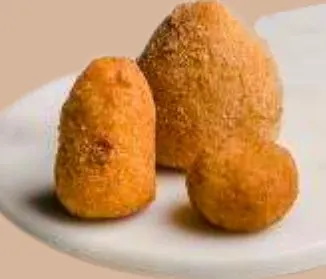
What Is an Arancino?
An arancino is a ball of risotto wrapped around a filling, coated in breadcrumbs and deep-fried. The rice is usually cooked with saffron, which gives it the golden colour that produced the name: arancino means little orange, and a tray of them does look like a crate of small citrus.
They are Sicilian, and Sicily has never entirely agreed on them. In Palermo they are round and called arancine, feminine; in Catania they are often conical and called arancini, masculine. The argument is genuinely regional, occasionally heated, and completely unresolvable. Australians say arancini and nobody minds.
What matters more than the name is the structure. An arancino is three things at once — a crisp fried shell, a layer of seasoned rice, and a molten centre. When one of the three is wrong, you notice immediately: a soggy shell, dry rice, or a cold middle. Almost every practical question about cooking them comes back to keeping those three in balance.
How to Cook Arancini Balls from Frozen
This is the question we get asked most, usually the afternoon before an event. The core principle: do not thaw them first. Frozen arancini go into the heat frozen. Thawing lets the rice release moisture into the crumb, and a wet crumb will never crisp — it will go pale and greasy instead.
The second principle is that the centre takes longer than the outside. The failure mode is a shell that is beautifully browned around a middle that is still cold, and it happens when the heat is too high. Whatever method you use, moderate heat for longer beats high heat for less time.
In the oven is the practical choice for any quantity. Spread them on a tray with space between them — crowding traps steam and steam is the enemy of the shell. Turn them once part-way through so the underside is not sitting in its own moisture.
In an air fryer works well for small numbers and is the best home method for keeping the shell crisp. The same rule applies: single layer, space between them, turn once.
Deep-frying gives the best result and is what a Sicilian bakery does, but from frozen it is genuinely easy to get wrong — oil hot enough to colour the crumb quickly will leave the centre cold.
Follow the cooking instructions on the pack you have rather than a time from the internet, because time depends on size, and a cocktail arancino and a large one are not remotely the same job. If you are ordering from us for a catering drop-off, the instructions come with the delivery. On a staffed booking you can ignore all of this — our team handles it.
How to Tell When They Are Done
Colour is a poor guide on its own, because the crumb browns long before the centre is hot. The reliable test is the middle: an arancino is ready when the centre is hot all the way through, and if there is cheese in the filling, when that cheese has actually melted.
The practical method when you are cooking a tray for guests is to sacrifice one. Cook the batch, take one out, cut it in half and look. If the centre is hot and the cheese has gone, the rest are ready. If it is not, everything goes back in and you have lost nothing but a single arancino — which is a far better outcome than serving forty cold ones.
Cut them in half and let them sit for a minute before serving if you are unsure. A molten centre straight out of the oven is genuinely hot enough to burn someone's mouth, which is worth remembering at an event with children.
What Sauce to Serve with Arancini Balls
The traditional Sicilian answer is: nothing. An arancino is seasoned inside, and in Sicily it is eaten as it comes, from a paper napkin, on the street. If yours are good, they need no help.
That said, a dipping sauce turns them into a better canapé — it gives guests something to do with them and it stretches the flavour across a longer service. The sauces that actually work:
- A simple tomato sugo. The default, and the one that never fails. Warm, loose enough to dip into, not sweet.
- Garlic aioli. Not remotely traditional and enormously popular in Australia. It suits the veal and chicken fillings particularly well.
- Basil pesto. Good with the vegetarian fillings, especially spinach and ricotta.
- A truffle or mushroom cream. Reserved for mushroom and truffle arancini, where it doubles down rather than competing.
What to avoid: anything sweet, anything with a lot of vinegar, and anything so thick it pulls the crumb off. The shell is the point, and a heavy sauce destroys it.
One sauce is enough for most events. Two is generous. Three is a queue at the table.
The Classic Fillings
Sicily has two canonical fillings, and everything else is a modern extension of them.
Al ragù — meat in tomato sauce, usually with peas, is the original and still the benchmark. If someone hands you an unlabelled arancino in Sicily, this is what is in it. Our veal arancini are the version of this we serve.
Al burro — béchamel with ham and cheese, is the other traditional filling, milder and richer.
Beyond those, the fillings that have become standard in Australian venues are spinach and ricotta, chicken and mushroom, mushroom and truffle, and pea and cheese. Two of those — spinach and ricotta, and pea and cheese — are vegetarian, and pea and cheese is closer to tradition than it sounds, since peas belong in the classic ragù anyway.
If you are choosing fillings for an event rather than for yourself, three is the number. One meat, one vegetarian, one that sounds interesting. Ordering a single filling for a large group is the most common ordering mistake we see, and it is always the vegetarians who pay for it.
Gluten-Free and Dietary Questions
A standard arancino is not gluten free. The rice is, and most fillings are, but the coating is breadcrumbs and the fried shell is the whole point of the dish — so the one component that cannot be quietly left out is the one that contains the gluten.
Gluten-free arancini do exist, made with gluten-free crumb, and they can be genuinely good. What they cannot be is cooked in the same oil as everything else: shared fryer oil carries gluten across, and for a coeliac guest that matters. If you need gluten-free arancini for an event, they have to be sourced and cooked as a separate item, and that has to be planned rather than improvised on the day.
The same logic applies to the fillings. Vegetarian arancini are straightforward; vegan is harder, because both traditional fillings are built on cheese or béchamel. Halal depends on the filling — the vegetarian ones are usually the simplest answer.
Our general advice, and it is the same advice we give about pizza dietary requirements: tell your caterer the numbers when you book, not on the day. Every dietary requirement has an answer if there is time to arrange it, and very few have a good answer at 6pm on a Saturday.
How Many to Order
Arancini are consistently under-ordered, for a simple reason: they are eaten during the part of an event when nobody is paying attention to how much they are eating.
As a starting point, alongside a full meal plan 2–3 cocktail arancini per guest; as part of a canapé selection, 3–4; and if they are the main savoury item at a drinks function, 5–6. Large arancini are a different item — one per guest on a buffet, because a large arancino is closer to a small meal than a canapé.
The number that catches people out is the first hour. Guests arrive hungry, there is a drink in their hand and nothing has been served yet, and whatever is on that table goes at roughly twice the rate you predicted. If you are ordering for a function where the main food starts late, weight the order towards the beginning.
For the full breakdown by event type, and for what we actually charge, see the arancini catering page.
Serving Arancini at an Event
Three things decide whether arancini land well at a function, and none of them is the recipe.
Timing. Arancini are best within a fairly short window of coming out of the heat. Cooked too early they lose the shell; cooked in batches across the service they stay right. If you are self-catering, cook in waves rather than all at once.
Temperature on the table. A crisp shell goes soft under a lid. If you are holding them, hold them uncovered and accept that they will cool, rather than covering them and steaming the crumb off. This is the single most common way a good arancino is ruined between the kitchen and the guest.
Napkins. Genuinely. They are fried, they are eaten in the hand, and they are usually served with a drink in the other one. Put more napkins out than feels necessary.
On a staffed catering booking none of this is your problem — the team cooks in waves, holds them correctly and puts them out at the right moment. On a drop-off, these three things are most of the difference between arancini that work and arancini that do not.
Planning a wider Italian table? Arancini sit naturally alongside the lasagna, eggplant parmigiana and meatball trays — see all our catering add-ons.
Frequently Asked Questions
How do you cook arancini balls from frozen?
Cook them from frozen — do not thaw them first, or the rice releases moisture into the crumb and the shell will never crisp. Use moderate heat for longer rather than high heat for less time, because the centre takes longer than the outside. Spread them in a single layer with space between them, in the oven or an air fryer, and turn them once part-way through. Follow the cooking instructions on your pack for timing, since a cocktail arancino and a large one are very different jobs.
What sauce goes with arancini balls?
Traditionally none — in Sicily arancini are seasoned inside and eaten as they come. For an event, a simple warm tomato sugo is the safest choice, garlic aioli is the most popular in Australia, basil pesto suits the vegetarian fillings, and a truffle or mushroom cream works with mushroom and truffle arancini. Avoid anything sweet, sharp with vinegar, or thick enough to pull the crumb off.
What are the traditional arancini fillings?
Sicily has two canonical fillings: al ragù (meat in tomato sauce, usually with peas) and al burro (béchamel with ham and cheese). Everything else — spinach and ricotta, chicken and mushroom, mushroom and truffle, pea and cheese — is a modern extension. For an event, order three fillings rather than one: a meat, a vegetarian, and one that sounds interesting.
Are arancini gluten free?
Standard arancini are not. The rice and most fillings are gluten free, but the coating is breadcrumbs and the fried shell is the point of the dish. Gluten-free arancini made with gluten-free crumb do exist, but they cannot share fryer oil with regular ones — shared oil carries gluten across. If you need them for an event, they must be sourced and cooked separately, and planned in advance.
How do you know when arancini are cooked through?
Colour is not a reliable guide, because the crumb browns well before the centre is hot. Cook the batch, take one out, cut it in half and check that the centre is hot through and any cheese has melted. If it has not, the whole tray goes back in — you have lost one arancino rather than served forty cold ones.
How many arancini do I need per person?
Alongside a full meal, 2–3 cocktail arancini per guest. As part of a canapé selection, 3–4. If they are the main savoury item at a drinks function, 5–6. Large arancini are a different item — one per guest on a buffet. Weight the order towards the first hour, when guests arrive hungry and nothing else has been served.
Related Planning Guides
Ready to Book Your Pizza Catering?
Get a free, no-obligation quote for your event today.
Get Free Quote